Outdoor Public Sculpture
Petrides now has 35 permanent public sculptures installed globally — 10 outdoors and 25 indoors — across corporate, educational, governmental, healthcare, museum, and religious institutions.

Thirty-five permanent sculptures presented as numbered dossiers — each rooted in a historical reference, documented to the surface grain, and specified to the millimeter. Explore the atlas, filter the register, magnify the patina.
Petrides now has 35 permanent public sculptures installed globally — 10 outdoors and 25 indoors — across corporate, educational, governmental, healthcare, museum, and religious institutions.
Hellenic Heads: Legacy and Renewal presented Paris as its 7th city and will open at the Embassy of Greece in Berlin as its 8th city in September 2026, followed by New York as its 9th city, and Athens as its 10th city homecoming finale.
Sulalat al-Mustaqbal is being prepared for exhibition in the Gulf. The short documentary Man of Two Wars is in final edit.
Born in Athens (1964) and based there and in New York, George Petrides is a contemporary sculptor known for public works and traveling exhibitions. His practice explores the intersection of personal narrative, cultural heritage, and technological innovation.
Petrides has 35 permanent installations globally. His sculptures are placed in prominent corporate, educational, governmental, healthcare, museum, and religious institutions — large outdoor and indoor works.
Hellenic Heads: Legacy and Renewal has reached over 100,000 visitors across Asia, Europe, and the U.S. Paris served as the 7th city, opening in Berlin in September 2026 as the 8th city, followed by New York as the 9th city, and returning to Athens for its 10th city homecoming finale. His next traveling exhibition, Sulalat al-Mustaqbal, will follow in the Gulf.
Petrides blends ancient traditions, inspired by his dual heritage, with twenty-first-century innovation. His methodology — a dialogue between the hand and the machine — begins in traditional clay, transitions through 3D scanning and digital sculpting, and is realized through custom printing processes using sustainable and upcycled materials. Some works are cast in bronze.
The rigor of Petrides' work is informed by his studies at Harvard College (B.A. Classics, 1985) and Stanford University (M.B.A. and M.A., 1993). The humanities provide the bedrock for his research; his graduate training supports the management that global public art projects demand. In his first career, Petrides held senior roles in international finance, including positions at Lazard Frères and Donaldson, Lufkin & Jenrette, where he was a Managing Director.
For more than 20 years, alongside his first career, Petrides studied and practiced art part-time. His principal art education was at The New York Studio School (enrolled 2001; degree in sculpture, 2022), with further study at the Académie de la Grande Chaumière in Paris and the Art Students League of New York. In 2017 he committed to sculpture full-time.
| Sector | Outdoor | Indoor | Total |
|---|---|---|---|
| Corporate | — | 5 | 5 |
| Educational | — | 3 | 3 |
| Government | 2 | 8 | 10 |
| Healthcare | 6 | 1 | 7 |
| Museum | 1 | 6 | 7 |
| Religious | 1 | 2 | 3 |
| Total | 10 | 25 | 35 |
Sited works from the documented dossiers, with the Hellenic Heads route — Venice 2024 · Paris (7th) · Berlin (8th, Sept 2026) · New York (9th) · Athens (10th Homecoming Finale). Further works are installed in Canada, France, Italy, Spain, and Türkiye; complete atlas on request.
Twelve representative works from the catalogue of thirty-five, in descending order of value.
The complete catalogue of thirty-five works is available on request — george@petrides.art.
Hover to magnify · click to open
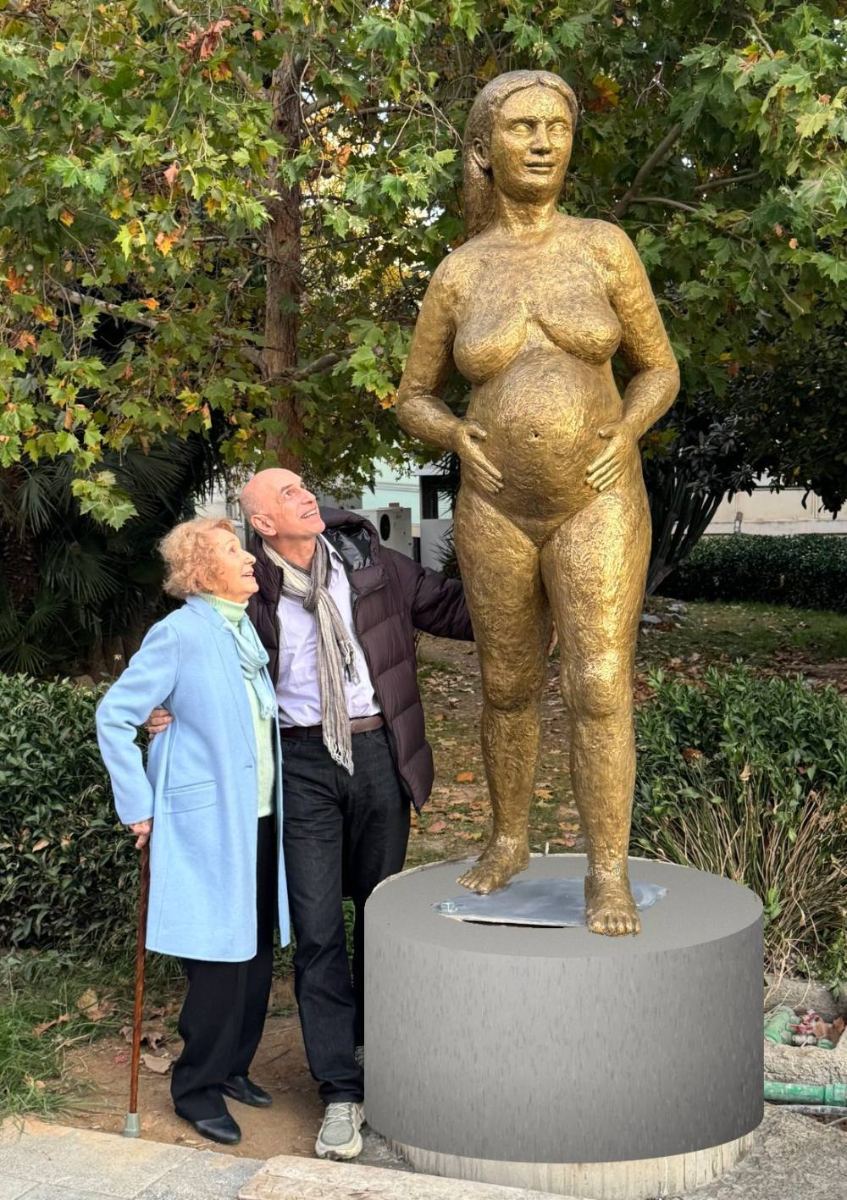
Detail · tapAretaieia stands at the entrance of Greece's first university hospital, on Vasilissis Sofias Avenue opposite the U.S. Embassy. The over-life-size figure honors the institution's OB-GYN service — in continuous operation since the 1880s — and the generations of mothers and children it has cared for.
The work also marks Petrides' first use of recycled materials, in this case salvaged from medical packaging made of PETG. The result is engineered for permanence with a substantially reduced embodied carbon footprint, and without compromise of surface or scale.
Hover to magnify · click to open
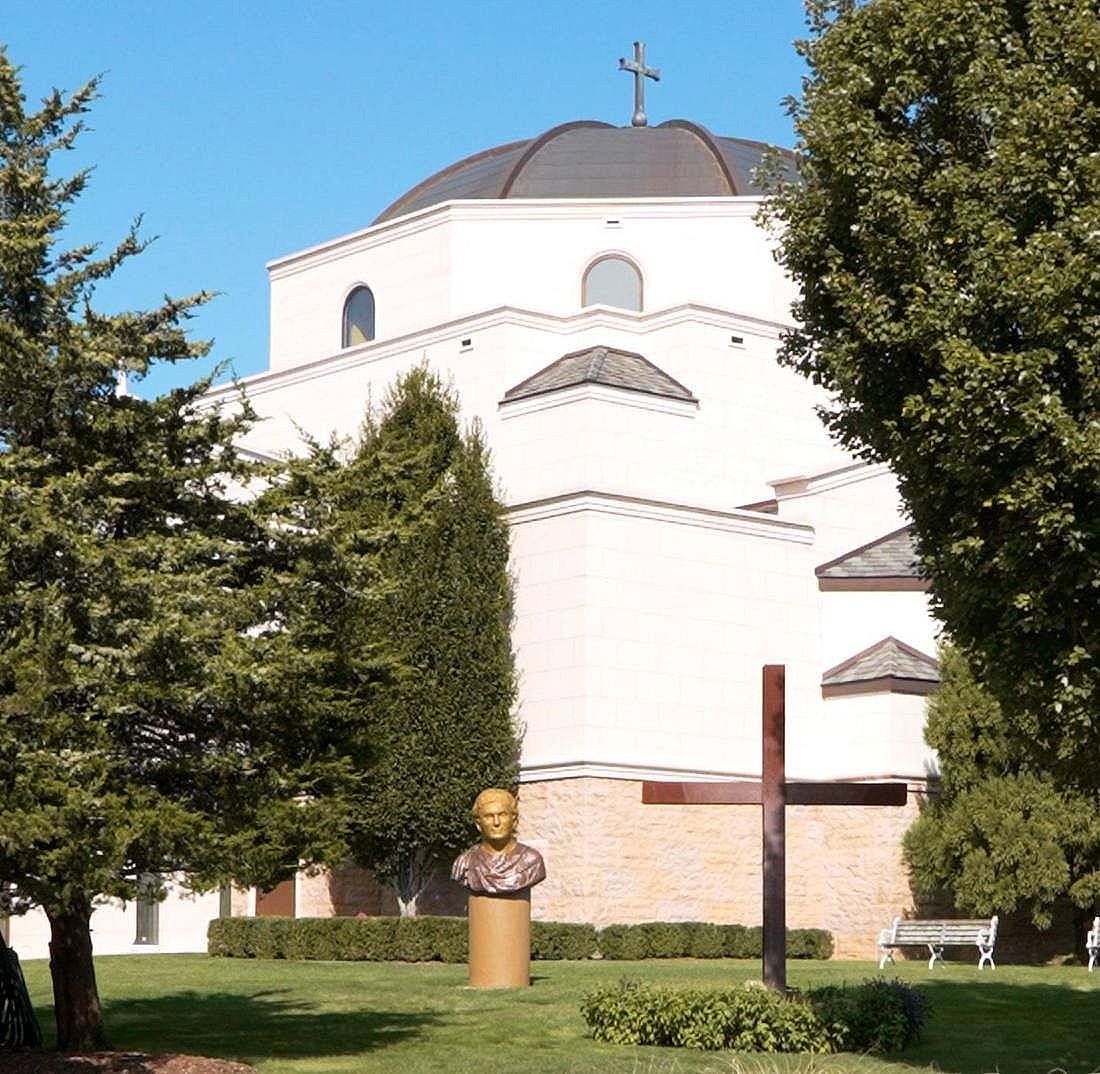
Detail · tapA prominent Greek Orthodox church welcomed this over-life-size bust of Constantine the Great, c. 272–337 — a pivotal figure in world history, ending official persecution of Christianity within the Roman Empire.
The sculpture depicts him at the Battle of the Milvian Bridge, fought outside Rome in 312; tradition holds that Constantine saw a heavenly sign of the cross and went on to victory. The church grounds already hold a cross fabricated from steel recovered from the World Trade Center towers.
Hover to magnify · click to open
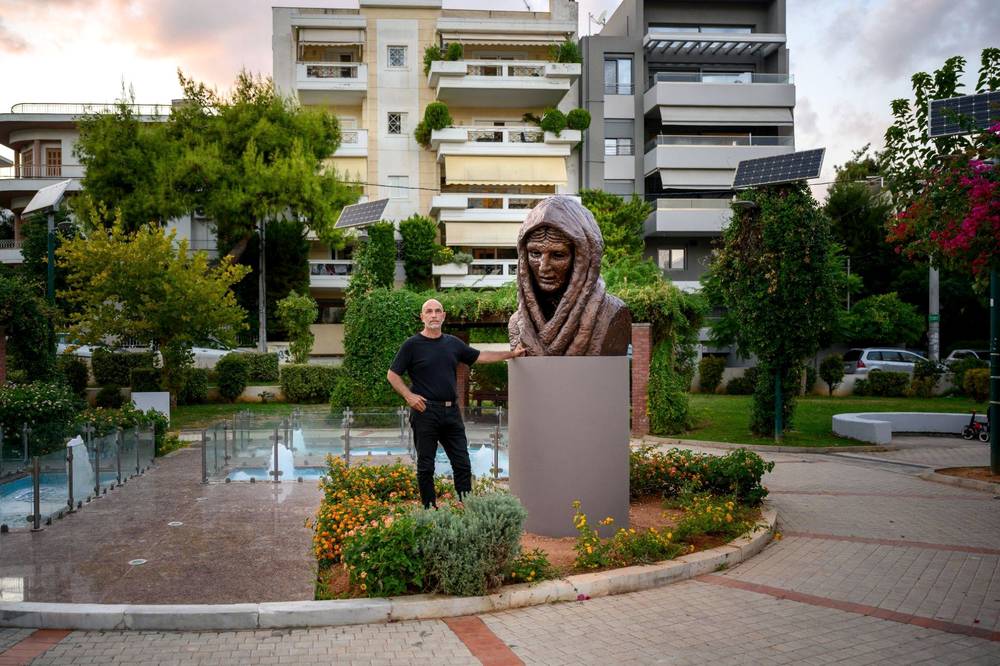
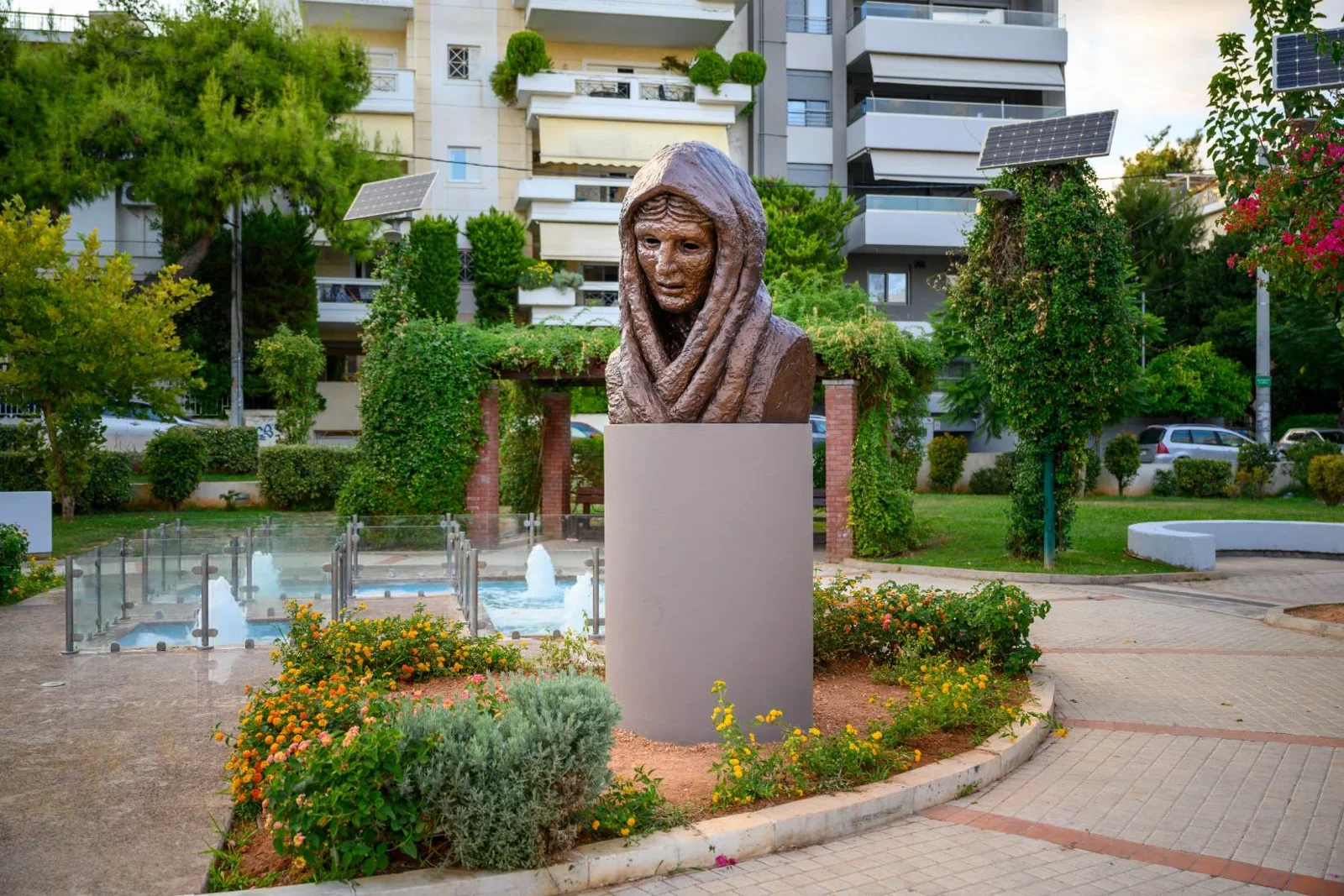
Detail · tapCommissioned for the centennial of the catastrophe of Smyrna in September 1922, this figure stands in Saint George Square in Neo Psychiko — one of the Athenian neighborhoods built specifically to absorb the more than one million Greek refugees who arrived from Asia Minor in the years that followed.
The figure is shaped by Petrides' imagining of his own maternal grandmother in the days when she left her homeland — a personal portrait standing in for an entire generation. She carries the bearing of those who lost everything but their composure.
Hover to magnify · click to open
Detail · tapThomas Jefferson — author of the Declaration of Independence adopted on July 4, 1776, first Secretary of State, two-term President, and founder of the University of Virginia — was a lifelong philhellene whose political thought drew on the democratic traditions of ancient Greece.
This bust was created to celebrate the nation's 250th anniversary. Petrides modeled the head from four period portraits that Jefferson and his family identified as the best likenesses.
Hover to magnify · click to open
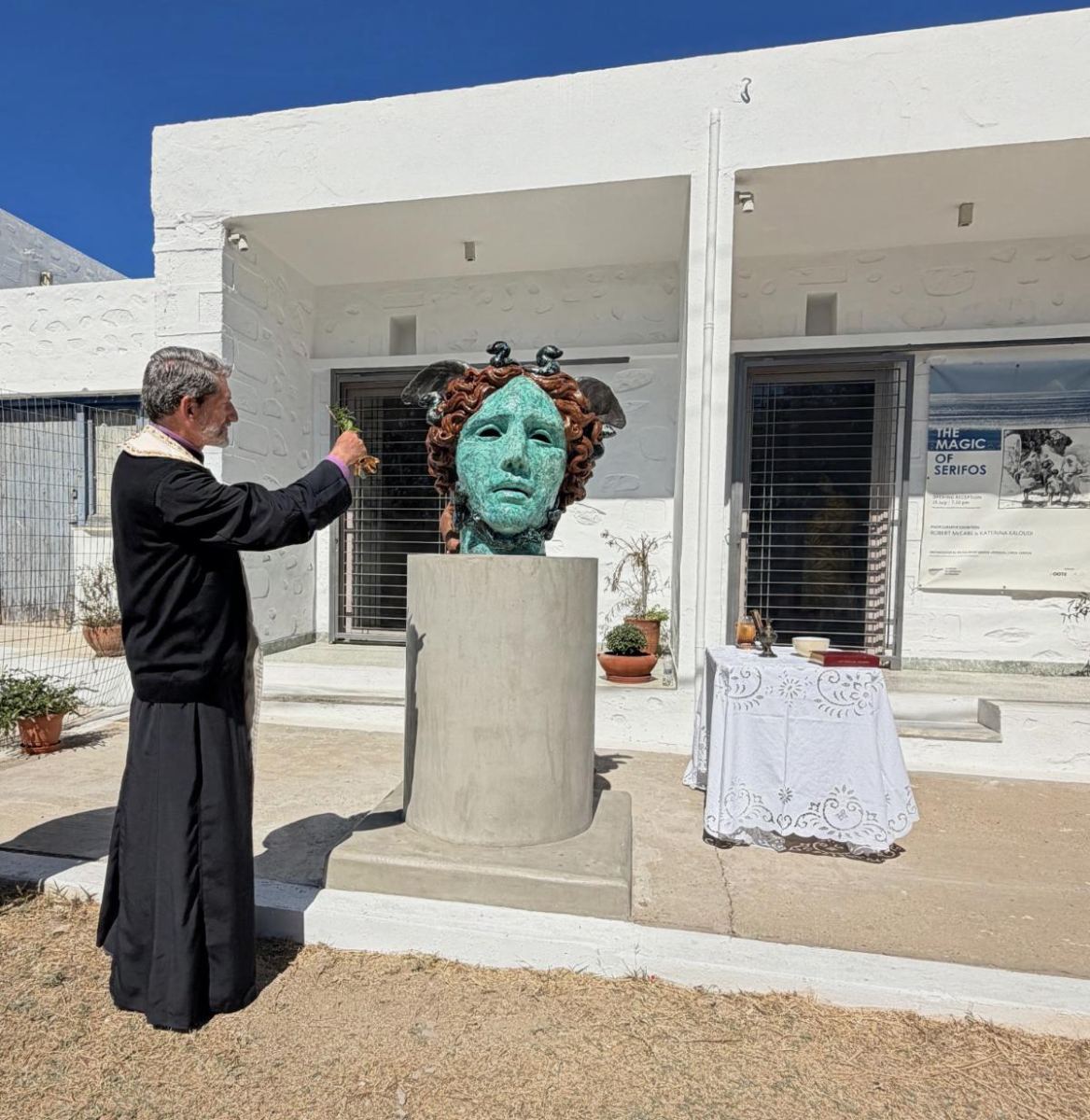
Detail · tapSerifos, in the Cyclades, occupies an important place in ancient Greek mythology: Perseus set out from the island to find and kill Medusa, freeing Andromeda before returning with her to Serifos.
Because Serifos has been mined for iron and copper since antiquity, Petrides chose to combine these two metals in a monumental head, installed on a concrete column in front of the Archaeological Museum, where it serves as a landmark for visitors.
Hover to magnify · click to open
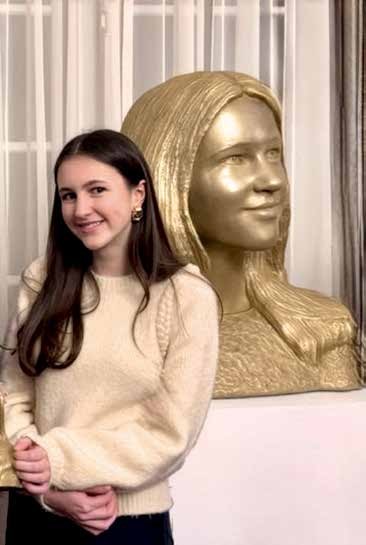
Detail · tapThis over-life-size bust stands at the entrance of one of the largest children's hospitals in Greece. Modeled by Sofia Petrides, the work was installed on its permanent base in front of the General Children's Hospital 'Aglaia Kyriakou' in Athens.
Kore has proven popular: variant Kore III is placed in the lobby of the Mission of Greece to the United Nations, while another Kore II is traveling to Berlin for the Hellenic Heads exhibition opening September 2026.
Hover to magnify · click to open
Detail · tapThis bust draws its inspiration from the lives and suffering of Greeks, both Jewish and Gentile, during the 1940s. The larger version is promised to the Holocaust Museum of Greece, now under construction. A reduction of the sculpture is already in the collection of the Jewish Museum of Greece in Athens.
For many of his sculptures, Petrides seeks out historical precedents. For this piece, the precedent is Rodin's Pierre de Wissant from The Burghers of Calais — six leading citizens who in 1347 offered their lives to spare their town.
Hover to magnify · click to open
Detail · tapThis variation of Thalia stands in the library of The Nightingale-Bamford School, finished in the school's athletic colors of silver and navy blue. Set among the reading room's tall windows and study tables, it places a daughter of classical antiquity at the center of student life.
For a school whose education is grounded in the humanities, the work is a daily reminder of the Greek inheritance — language, philosophy, art, and civic ideals — that continues to shape the liberal arts.
Hover to magnify · click to open
Detail · tapThis tabletop sculpture captures the instant of contact in one of the distinctive strokes of Court Tennis — also called real tennis or jeu de paume, the medieval indoor racquet game from which lawn tennis descends.
The work is sited at The Queen's Club, founded in 1886, one of the most historic racquet-sports venues in the world, known to most tennis lovers as the grass-court warm-up to Wimbledon.
Hover to magnify · click to open
Detail · tapThis tabletop sculpture depicts Davy Crockett at the Battle of the Alamo at daybreak on March 6, 1836. The frontiersman, congressman, and folk hero is shown in mid-action amid the rubble of the mission walls, astride the destroyed 18-pounder cannon, holding a torch to light the darkness while brandishing a Bowie knife.
The sculpture was accepted by the White House as a Presidential Gift — one of very few works selected in 2025. It will be displayed in the White House and subsequently transferred to the Presidential Library.
Hover to magnify · click to open
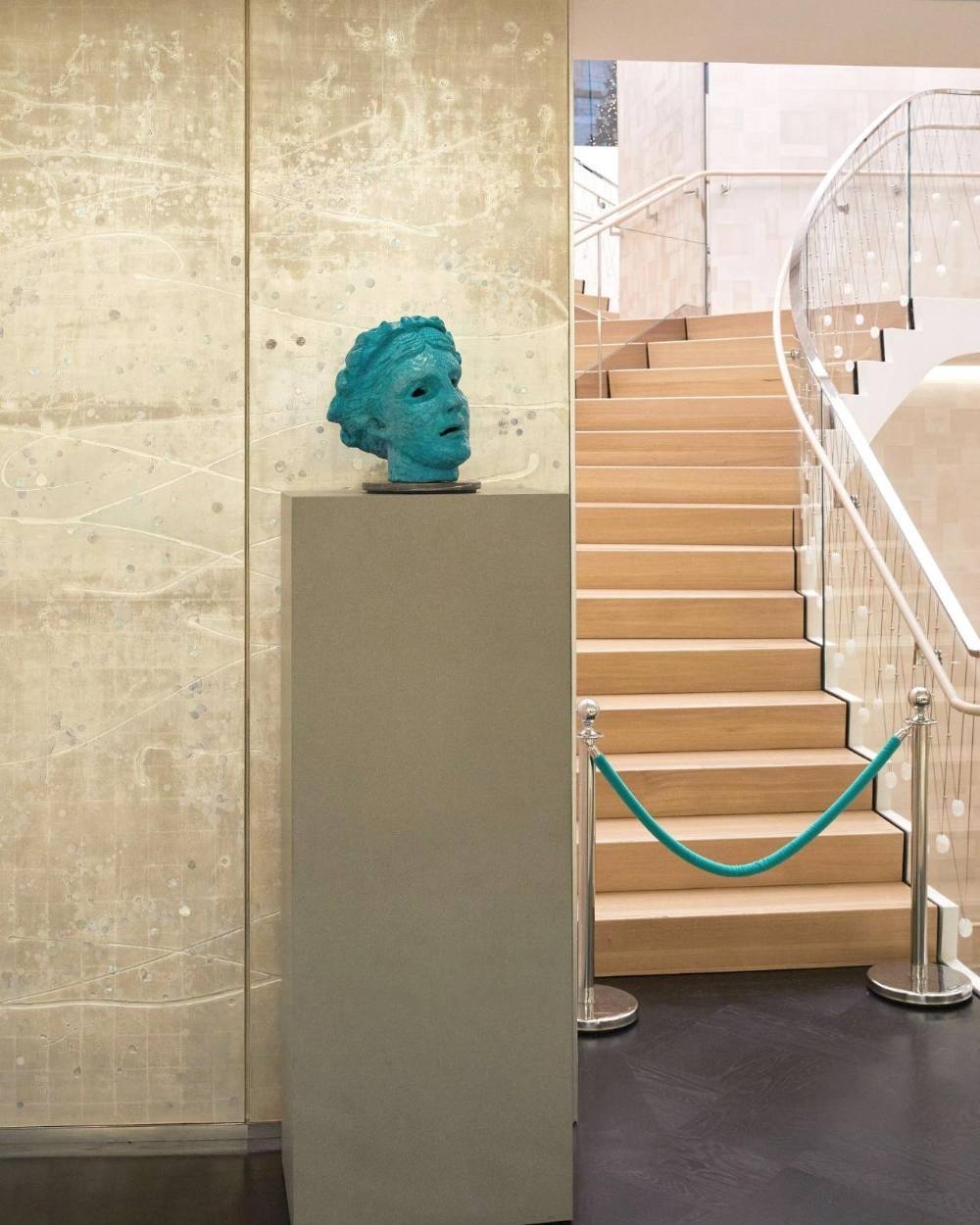
Detail · tapFor the opening of its global flagship at 727 Fifth Avenue, Tiffany & Co. and Peter Marino commissioned Petrides to contribute a work to an important contemporary art collection featuring leading artists.
Petrides modeled the head in clay, imagining his mother as a young woman, aided by black-and-white photographs from around 1950. The work was cast in bronze at a Greek foundry near ancient Thebes and finished in a custom patina developed to match Tiffany & Co.'s signature color. The piece takes its name from the Roman sculpture of Thalia, muse of comedy and idyllic poetry, in the Musei Vaticani.
Hover to magnify · click to open
Detail · tapPetrides was commissioned to create a presentation piece for the apostolic visit of His All-Holiness Ecumenical Patriarch Bartholomew to the United States. The subject — Constantine the Great — carries deep resonance: the seat of the Patriarchate is in present-day Istanbul, historic Constantinople, the imperial capital founded by Constantine in 330 AD.
His All-Holiness was pleased with the work and ordered a second, larger piece made of sustainable materials — consistent with his reputation as the Green Patriarch.
Every work begins as a hand-modeled clay original — the dialogue starts with the hand.
The clay is captured at high resolution, preserving every tool mark and surface decision.
The form is refined and scaled digitally, from tabletop to monumental.
Large-format fabrication in sustainable and upcycled materials, engineered for permanence.
Brass, bronze, iron, copper, gold coatings and custom patinas — or full bronze casting at a Greek foundry.
Six Greek historical periods, posed for by six Petrides family members
Five Middle Eastern historical periods, posed for by five Petrides family members
Hover to magnify · click to openThis traveling exhibition has been seen by over 100,000 visitors, with high attendance when it was shown in parallel with the 2024 Venice Biennale. Pictured here, the exhibition is sited in the courtyard of San Giorgio dei Greci in Venice — an Orthodox church begun in 1539, founded by the Greeks who settled in Venice after the fall of Constantinople.
The exhibition consists of six over-life-size busts, each referencing a historical era from ancient Greece to the present, modeled by members of Petrides' family and fabricated in recycled material. The sculptures are accompanied by videos, informational panels, a catalog, and a dedicated website.